Chef's knife - for a true cook
This interesting article will focus on the appearance of a chef's knife. Experienced chefs can take note of the main points of this article to find a knife that meets all the basic parameters.
This interesting article will focus on the appearance of a chef's knife. Experienced chefs can take note of the main points of this article to find a knife that meets all the basic parameters.
Chef's knife - The chef's most important tool. Considering how much time a chef spends holding it during their working day, it's imperative that the knife be very good.
Most chefs usually advise buying the most expensive knife you can afford. But this advice is unlikely to help you if you don't know what to buy. You might buy the most expensive knife, but it will be completely useless in your kitchen.
So, the best kitchen knives are forged from a single piece of steel that runs the entire length of the knife, from the tip of the blade to the end of the handle. Below, we'll discuss the various parts of a true chef's knife.
Blade
The best kitchen knives are made of high-carbon stainless steel, a very durable metal. Knives made from this metal last a long time and don't corrode like tools made from regular carbon steel.
Of course, this doesn't mean other knives are inferior. Some chefs even prefer them because they're easier to sharpen. However, they also dull much faster.
The blade length of any knife is usually measured in inches, and a typical kitchen knife blade length is between 8 and 12 inches, which is approximately 20-30 cm. A longer blade allows you to get longer slices when cutting food.
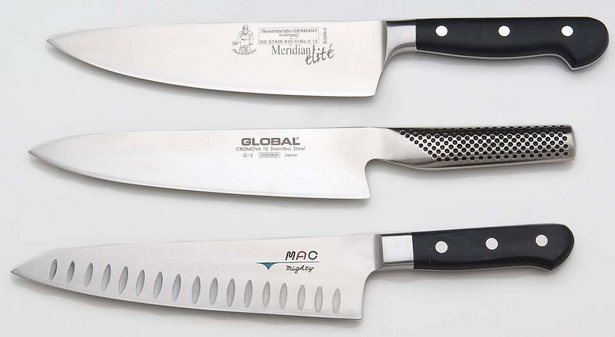
German knives have a slightly curved blade at the tip, making it ideal for slicing food using an up-and-down rocking motion. French knives have a straight, triangular blade. These blades are ideal for slicing when long, straight strokes are required. Japanese knives have small indentations, or air pockets, along the blade that trap air between the knife and the food being cut, reducing friction and food sticking to the knife.
Knife handle
The most important thing about a handle is that it fits your hand perfectly. It shouldn't be slippery or cause any discomfort to your palm.
Traditional kitchen knife handles are made of wood, but wood isn't always suitable for kitchen conditions. Wood is porous, so it harbors bacteria that can cause various gastrointestinal illnesses. Many restaurant management bans knives with wooden handles from their kitchens.
Bacteria can also get into the tiny cracks where the wood of the handle meets the steel, as well as in rivets. Knives with wooden handles are difficult to clean in dishwashers, and prolonged soaking can cause the wood to warp and crack.
For this reason, knives with plastic or rubber handles are more commonly used in the kitchen. Sometimes handles are made of a composite material consisting of wood impregnated with various plastic resins. These handles look like regular wood, which is quite attractive, but without any sanitation issues.
Cutting edge
Knives with large blades have a larger cutting edge, allowing for more force to be applied when cutting food. A heavy knife also requires greater force, but using such knives can be quite tiring.
The cutting edge of the blade, located almost at the handle, is designed for crushing hard foods such as carrots, nuts or even chicken bones.
Lever
As mentioned earlier, good knives are forged from a single piece of steel that runs the entire length of the knife. This means the blade doesn't end where the knife meets the handle. Besides providing strength, this is also necessary for ease of use. Sometimes the steel fills only a small portion or half of the handle. Such knives are awkward to use. They are weak and unstable. No self-respecting chef would use such a knife, even if they got it for free.
Rivets
Knife rivets are cylindrical screws that attach the steel to the handle. They are typically found on knives with wooden handles. If you have a wooden handle, make sure all the rivets are flush with the rest of the handle before you begin cutting, ensuring they don't protrude or cause discomfort. Otherwise, you could injure yourself later while working.
Chef's knife - The chef's most important tool. Considering how much time a chef spends holding it during their working day, it's imperative that the knife be very good.
Most chefs usually advise buying the most expensive knife you can afford. But this advice is unlikely to help you if you don't know what to buy. You might buy the most expensive knife, but it will be completely useless in your kitchen.
So, the best kitchen knives are forged from a single piece of steel that runs the entire length of the knife, from the tip of the blade to the end of the handle. Below, we'll discuss the various parts of a true chef's knife.
Blade
The best kitchen knives are made of high-carbon stainless steel, a very durable metal. Knives made from this metal last a long time and don't corrode like tools made from regular carbon steel.
Of course, this doesn't mean other knives are inferior. Some chefs even prefer them because they're easier to sharpen. However, they also dull much faster.
The blade length of any knife is usually measured in inches, and a typical kitchen knife blade length is between 8 and 12 inches, which is approximately 20-30 cm. A longer blade allows you to get longer slices when cutting food.
German knives have a slightly curved blade at the tip, making it ideal for slicing food using an up-and-down rocking motion. French knives have a straight, triangular blade. These blades are ideal for slicing when long, straight strokes are required. Japanese knives have small indentations, or air pockets, along the blade that trap air between the knife and the food being cut, reducing friction and food sticking to the knife.
Knife handle
The most important thing about a handle is that it fits your hand perfectly. It shouldn't be slippery or cause any discomfort to your palm.
Traditional kitchen knife handles are made of wood, but wood isn't always suitable for kitchen conditions. Wood is porous, so it harbors bacteria that can cause various gastrointestinal illnesses. Many restaurant management bans knives with wooden handles from their kitchens.
Bacteria can also get into the tiny cracks where the wood of the handle meets the steel, as well as in rivets. Knives with wooden handles are difficult to clean in dishwashers, and prolonged soaking can cause the wood to warp and crack.
For this reason, knives with plastic or rubber handles are more commonly used in the kitchen. Sometimes handles are made of a composite material consisting of wood impregnated with various plastic resins. These handles look like regular wood, which is quite attractive, but without any sanitation issues.
Cutting edge
Knives with large blades have a larger cutting edge, allowing for more force to be applied when cutting food. A heavy knife also requires greater force, but using such knives can be quite tiring.
The cutting edge of the blade, located almost at the handle, is designed for crushing hard foods such as carrots, nuts or even chicken bones.
Lever
As mentioned earlier, good knives are forged from a single piece of steel that runs the entire length of the knife. This means the blade doesn't end where the knife meets the handle. Besides providing strength, this is also necessary for ease of use. Sometimes the steel fills only a small portion or half of the handle. Such knives are awkward to use. They are weak and unstable. No self-respecting chef would use such a knife, even if they got it for free.
Rivets
Knife rivets are cylindrical screws that attach the steel to the handle. They are typically found on knives with wooden handles. If you have a wooden handle, make sure all the rivets are flush with the rest of the handle before you begin cutting, ensuring they don't protrude or cause discomfort. Otherwise, you could injure yourself later while working.
Votes: 1
Categories:
Related articles