Banh Tieng
Votes: 1

Time: 8 hours 30 minutes
Complexity: average
Servings: 6
Complexity: average
Servings: 6
Nutritional value per serving:
Calories 1256, total fat 51 G., saturated fats 23 G., proteins 26 G., carbohydrates 175 G., fiber 9 G., cholesterol 54 mg, sodium 1024 mg, sugar 22 G.
Calories 1256, total fat 51 G., saturated fats 23 G., proteins 26 G., carbohydrates 175 G., fiber 9 G., cholesterol 54 mg, sodium 1024 mg, sugar 22 G.
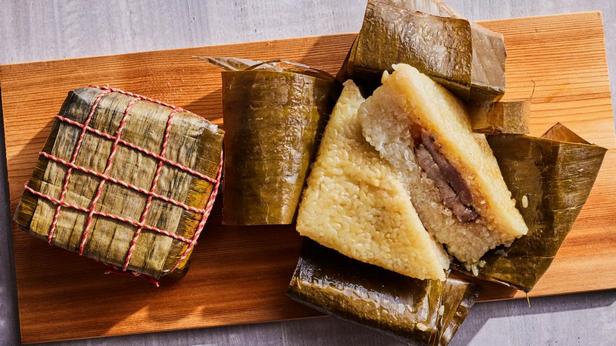
For the Vietnamese diaspora, glutinous rice cakes are considered a staple New Year's treat. Residents of southern Vietnam call them bánh têt and shape them cylindrically. In the north, they are rectangular and called bánh chưng. Fillings vary depending on each family's preferences, but the three most popular ingredients are pork belly, mung beans, and glutinous rice. Assembling these banana-shaped cakes is a multi-step process that, like many holiday dishes, requires preparation and time. However, it's another great excuse to gather with family and friends in the kitchen. This recipe makes six bánh chưng, but you can easily double the ingredients to make enough for everyone and share with neighbors.
The recipes use measuring containers with the following volumes:
1 glass (st.) - 250 ml.
3/4 cup (st.) - 180 ml.
2/3 cup (st.) - 160 ml.
1/2 cup (st.) - 125 ml.
1/3 cup (st.) - 80 ml.
1/4 cup (st.) - 60 ml.
1 tablespoon (tbsp) - 15 ml.
1 teaspoon (tsp) - 5 ml.
1/5 teaspoon (tsp) - 1 ml.
1 glass (st.) - 250 ml.
3/4 cup (st.) - 180 ml.
2/3 cup (st.) - 160 ml.
1/2 cup (st.) - 125 ml.
1/3 cup (st.) - 80 ml.
1/4 cup (st.) - 60 ml.
1 tablespoon (tbsp) - 15 ml.
1 teaspoon (tsp) - 5 ml.
1/5 teaspoon (tsp) - 1 ml.
Ingredients for the recipe:
- 900 gr. sticky rice
- 150 gr. chopped masha
- 450 g pork belly
- 2 tbsp + 1.5 tsp fish sauce
- 4 tsp ground black pepper
- 1/4 tbsp. coconut oil
- 110 g shallots, thinly sliced
- 2 teaspoons coarse salt
- 900 g fresh banana leaves
- Special equipment: kitchen twine; 6-quart Instant Pot (optional); 10x10x5 cm banh chưng pan; cheesecloth-lined steamer
We recommend







Cooking the dish according to the recipe:
- Day 1Soak the glutinous rice and mung beans. Marinate the pork belly. Fry the shallots.
Place the rice in a large bowl and add 4 liters of water. Refrigerate, uncovered, overnight. Place the beans in a bowl and add 1 liter of water. Refrigerate, uncovered, overnight. - Slice the pork belly into 1-cm-thick slices, then cut the slices into 1-cm-thick pieces. Combine the sliced pork, fish sauce, and 2 teaspoons of black pepper in a bowl. Stir to coat the pork with the marinade. Cover and marinate in the refrigerator overnight.
- Place the coconut oil in a skillet and heat over medium heat. Add the shallots. Cook, stirring constantly, until fragrant and softened, 3–6 minutes. Transfer the shallots to a bowl. Season with 1/4 teaspoon of salt and 1/2 teaspoon of black pepper and toss to combine. Cover and refrigerate until ready to use.
- Day 2Steam the mung beans. Prepare the banana leaves. Make and fill the banana leaf box. Make the bánh chưng.
Drain the mung beans in a colander. Roll them into a bowl, cover with clean water, rinse, and drain again. Repeat one more time. - Place the mung beans in a cheesecloth-lined steamer. Steam over medium-high heat until tender, at least 15 minutes. After 15 minutes, check the mung beans for doneness by removing one and squeezing it between your fingers. If it softens easily, it's ready. If not, continue steaming until done.
- Transfer the mung beans to a bowl. Sprinkle the hot mung beans with the remaining 1 3/4 teaspoons of salt and 1.5 teaspoons of black pepper. Stir to evenly distribute the salt and pepper. Cover and refrigerate until ready to use.
- Drain the sweet rice in a colander. Return it to the bowl, cover with clean water, rinse, and drain again. Repeat one more time. Set aside to drain.
- Banana leaves:
Bring a large saucepan of water to a boil. Prepare a large bowl of ice water. Wash the banana leaves. Cut the banana leaves along the grain into 10cm-wide strips. Working in batches, quickly drop the strips into boiling water, then immediately plunge them into ice water. Remove the leaves from the water, pat dry, and set aside. - Banana leaf box:
Fold a strip of leaf over by 10 cm. Place it in the bánh chưng mold so that the fold is flush with the left side of the mold. Make a corresponding fold so that it fits flush with the right side of the mold. Fold another strip of leaf and place the folded edge inside the mold so that the folded edge is pressed against the top of the mold. Make a corresponding fold so that it fits flush with the bottom of the mold. Repeat with 4 more strips of leaf, alternating directions. Insert 2 leaves along the inner perimeter of the mold. The resulting banana leaf box is ready for filling.Traditional bánh chưng molds are typically handmade, square wooden frames. You can make molds from empty milk cartons. Simply cut off the bottom and top of the cardboard carton, then cut it into 5cm-wide sections. When you're done making the bánh chưng, simply discard the molds. - Filling:
Spoon 1 cup of rice into the box. Pack the rice down to create a flat bottom and spread the rice up the sides of the box. Place 2 slices of pork belly in the center of the box, making sure it doesn't touch the sides. Add 2 tablespoons of mung beans and 1.5 teaspoons of shallots to the center. Add 1/3 cup of rice and pack the rice down so it's flush with the edge of the box. Fold the overhanging leaves to close the box. Trim any excess. - Place a 90 cm piece of kitchen twine across the top of the box. Carefully turn the box over. Remove the mold. Wrap the twine tightly around the box, as if wrapping a gift. Set aside and repeat with the remaining banana strips, filling, and twine. The bánh chưng can now be cooked in a pressure cooker or steamed on the stovetop.
- Pressure cooker:
Place the bánh chưng in a 6-liter slow cooker and add enough water to cover by 2.5 cm. Follow the manufacturer's instructions, close the lid, and prepare the slow cooker. Cook on high power for 45 minutes.
Note
Your multicooker settings may vary depending on the model. Always follow the manufacturer's instructions. - Once the pressure cooker cycle is complete, follow the manufacturer's instructions to set the pressure release to rapid pressure release and wait for the cycle to complete. Open and remove the lid carefully to avoid scalding from steam.
- On the stove:
Place a wire rack in a tall stockpot with a tight-fitting lid. Place the bánh chưng in the pot. Pour enough water into the pot to cover the bánh chưng by 30 cm. Bring the water to a boil, then cover, reduce the heat, and simmer for 8 hours. Transfer the bánh chưng to a baking sheet. If not serving immediately, let the bánh chưng cool. Wipe dry and refrigerate. Steam the bánh chưng until heated through, 10–15 minutes.
Categories: