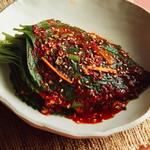
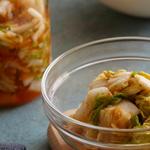
Oy-sobagi (Spicy pickled Korean cucumbers or cucumber kimchi)
Votes: 1


Time: 5 hours 35 minutes (including soaking, straining, fermentation)
Complexity: easily
Servings: 4
Complexity: easily
Servings: 4
Nutritional value per serving:
Calories 94, total fat 2 G., saturated fats 0 G., proteins 4 G., carbohydrates 20 G., fiber 4 G., cholesterol 5 mg, sodium 737 mg, sugar 7 G.
Calories 94, total fat 2 G., saturated fats 0 G., proteins 4 G., carbohydrates 20 G., fiber 4 G., cholesterol 5 mg, sodium 737 mg, sugar 7 G.
This spicy cucumber kimchi is a great summer side dish. "Oi" means "cucumber" in Korean, and "sobagi" means it's been sliced crosswise and stuffed with a spice mixture. It's often made with Korean cucumbers, which have very thin skins and few seeds, but this recipe uses long, smooth-skinned cucumbers that also remain firm and crisp during the fermentation process. Unlike traditional cabbage kimchi, cucumber kimchi shouldn't be stored for more than a week. It's best eaten within two to three days.
The recipes use measuring containers with the following volumes:
1 glass (st.) - 250 ml.
3/4 cup (st.) - 180 ml.
2/3 cup (st.) - 160 ml.
1/2 cup (st.) - 125 ml.
1/3 cup (st.) - 80 ml.
1/4 cup (st.) - 60 ml.
1 tablespoon (tbsp) - 15 ml.
1 teaspoon (tsp) - 5 ml.
1/5 teaspoon (tsp) - 1 ml.
1 glass (st.) - 250 ml.
3/4 cup (st.) - 180 ml.
2/3 cup (st.) - 160 ml.
1/2 cup (st.) - 125 ml.
1/3 cup (st.) - 80 ml.
1/4 cup (st.) - 60 ml.
1 tablespoon (tbsp) - 15 ml.
1 teaspoon (tsp) - 5 ml.
1/5 teaspoon (tsp) - 1 ml.
Ingredients for the recipe:
For pre-salting cucumbers
- 5 cups of warm filtered drinking water
- 4 tbsp. Korean coarse sea salt (can be replaced with premium rock salt or any pickling salt)
- 1 kg. cucumbers (about 6-8 pcs.)
Thickener for marinade
- 1 tbsp. glutinous rice flour
- 1/4 teaspoon sugar
- 0.5 cups of water
Marinade for pickling
- 30 g carrots (about 2.5 cm), cut into strips
- 30 g chopped Chinese green onions
- A quarter of a small onion, thinly sliced
- 1/4 cup gochukaru (Korean chili flakes, + 2 tbsp to taste), sold in specialized Asian food stores and in the Ozon online store
- 2 tablespoons fish sauce
- 2 tablespoons of crushed garlic
- 1 tbsp red pepper flakes (or hot chili flakes, optional)
- 1 tbsp fermented salted shrimp (Asian shrimp paste)
- 1 teaspoon of sugar
- Marinade thickener (see ingredients above)
We recommend







Recipes with similar ingredients: cucumbers, green onions, red pepper flakes, carrot, fish sauce, kimchi
Cooking the dish according to the recipe:
- Prepare the brine for the cucumbers: In a large bowl, dissolve the salt in 5 cups of warm water, then set the brine aside.
- Prepare the cucumbers: Trim the ends of the cucumbers, then cut each cucumber in half crosswise. Cut each half lengthwise from the wider end until you reach 1 cm from the thinner end. Don't cut the cucumber all the way through. Rotate the cucumber 90 degrees and cut again. You now have four equal cucumber slices, joined together at the thinner end.
- Place cucumbers in brine and soak., until they can open slightly without breaking, for 3–4 hours. Place the cucumbers, cut side down, in a colander for 1 hour.
- Prepare a thickener for the marinade: Meanwhile, in a small saucepan, combine the rice flour, 1/4 teaspoon sugar, and 1/2 cup water. Heat over medium-high heat, stirring constantly, until thickened, 4–5 minutes. The mixture will begin to bubble after about 2 minutes. It's ready when it becomes a thick paste. Set the paste aside until ready to use.
- Prepare a marinade for pickling cucumbers: Combine carrots, green onions, onions, gochukara, fish sauce, garlic, chili flakes, salted shrimp, remaining 1 teaspoon sugar, and rice paste (thickener) in a medium bowl.
- Working with one cucumber at a time, hold the slices open with one hand and use the other to spoon the vegetable mixture between the slices, spreading it evenly across the cut edges. Serve immediately or transfer to a container, seal tightly, and let sit at room temperature for 4–6 hours to allow the flavor to develop. Kimchi tastes best chilled, so refrigerate it for at least an hour before serving. Can be stored in the refrigerator for up to 1 week.
- Korean coarse sea salt:
The strength and flavor of kimchi depend on the type of salt you use. We recommend purchasing Korean coarse sea salt (cheonilyeom). It is minimally processed and produced using an ancient method that involves long, slow sun drying to remove bitterness. Korean sea salt has a slightly sweet flavor. Different types of salt also contain different amounts of sodium. This can affect the quality and flavor of the finished kimchi.
Author of the recipe - Jackie Ji Yoon Park is a Korean culinary stylist and recipe developer, a registered dietitian, specializing in Korean cuisine.
Categories:
Recipe collections
















Similar recipes