Classic Eggs Benedict
Votes: 2

Time: 50 min.
Complexity: easily
Servings: 4
Complexity: easily
Servings: 4
Nutritional value per serving:
Calories 833, total fat 67 G., saturated fats 38 G., proteins 32 G., carbohydrates 28 G., fiber 3 G., cholesterol 674 mg, sodium 780 mg, sugar 2 G.
Calories 833, total fat 67 G., saturated fats 38 G., proteins 32 G., carbohydrates 28 G., fiber 3 G., cholesterol 674 mg, sodium 780 mg, sugar 2 G.
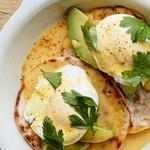
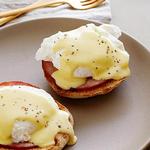
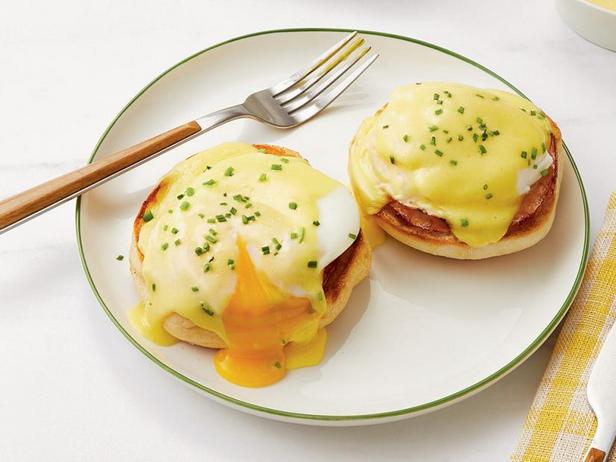
There are several conflicting theories about the origins of Eggs Benedict, but most agree that the dish was invented in New York City in the late 19th century. Hollandaise sauce, however, dates back much further: it is mentioned in a French cookbook from 1651 and was later known as Isigny sauce, named after the city in Normandy. The name was changed to "Dutch" after World War I, when butter was scarce in France and had to be imported from Holland. The classic Eggs Benedict brunch recipe, originating in New York City, consists of an English muffin, halved and fried, topped with poached eggs, Canadian bacon, and Hollandaise sauce.
The recipes use measuring containers with the following volumes:
1 glass (st.) - 250 ml.
3/4 cup (st.) - 180 ml.
2/3 cup (st.) - 160 ml.
1/2 cup (st.) - 125 ml.
1/3 cup (st.) - 80 ml.
1/4 cup (st.) - 60 ml.
1 tablespoon (tbsp) - 15 ml.
1 teaspoon (tsp) - 5 ml.
1/5 teaspoon (tsp) - 1 ml.
1 glass (st.) - 250 ml.
3/4 cup (st.) - 180 ml.
2/3 cup (st.) - 160 ml.
1/2 cup (st.) - 125 ml.
1/3 cup (st.) - 80 ml.
1/4 cup (st.) - 60 ml.
1 tablespoon (tbsp) - 15 ml.
1 teaspoon (tsp) - 5 ml.
1/5 teaspoon (tsp) - 1 ml.
Ingredients for the recipe:
Hollandaise sauce
- 220 g unsalted butter
- 3 large egg yolks
- 4 tsp freshly squeezed lemon juice
- 2 pinches of cayenne pepper
- Coarse salt
Eggs Benedict
- 2 tablespoons white wine vinegar
- 8 large eggs
- 2 tbsp unsalted butter, plus extra for greasing
- 8 slices Canadian bacon
- 4 English muffins, cut in half
- Chopped fresh chives for topping
We recommend







Recipes with similar ingredients: eggs, butter, lemon juice
Cooking the dish according to the recipe:
- Prepare the hollandaise sauce:
In a small saucepan over medium heat, melt the butter until it stops foaming (but does not darken), 6–8 minutes. Pour the clear butter into a liquid measuring cup, leaving the solids at the bottom of the pan; discard. - In a medium saucepan, heat 1 inch (2.5 cm) of water over medium heat until steaming (do not boil). In a medium stainless steel bowl, combine the egg yolks, 1 tablespoon (1.5 ml) of water, and 2 teaspoons (1.5 ml) of lemon juice. Place the bowl over the saucepan (the bottom should not touch the water). Cook, whisking constantly, until the egg mixture turns pale yellow and thickens, 3 to 5 minutes. Check periodically to make sure the water is not boiling, as this may cause the yolks to curdle.
- Remove the bowl from the pan and gradually pour in the melted butter, a drop at a time at first, whisking constantly, until the sauce thickens. Stir in the remaining 2 teaspoons lemon juice, cayenne pepper, and 1/4 teaspoon salt. If the sauce is too thick, stir in a little warm water, 1 tablespoon at a time. Return the bowl to the pan, turning off the heat to keep the sauce warm; stir occasionally.
- Make Eggs Benedict:
Fill a large, wide saucepan with 3 inches of water. Heat over medium-high heat until steaming and bubbling; reduce heat if necessary to maintain a gentle simmer. Add the vinegar. Crack 4 eggs into separate small bowls or cups. Carefully lower the eggs into the water, spreading them as far apart as possible. Cook until the whites are set but the yolks are still runny, 3 to 3 1/2 minutes. Remove the eggs with a slotted spoon to a plate lined with a kitchen towel. Gently pat dry with paper towels and trim off any thin bits. Repeat with the remaining 4 eggs. - In a large skillet, melt the butter over medium-high heat. Add the Canadian bacon and cook until lightly browned and heated through, 1–2 minutes per side. Meanwhile, toast the English muffins and brush with butter.
- Place a slice of Canadian bacon and a poached egg on each English muffin half. If needed, thin the hollandaise sauce with warm water and season with salt. Arrange the poached eggs on the sandwiches and sprinkle with chives.
Categories:
Recipe collections





Similar recipes