Mulnaengmyeon
Kitchen:Asian,
Time: 8 hours 45 minutes Complexity: average
Servings: 4
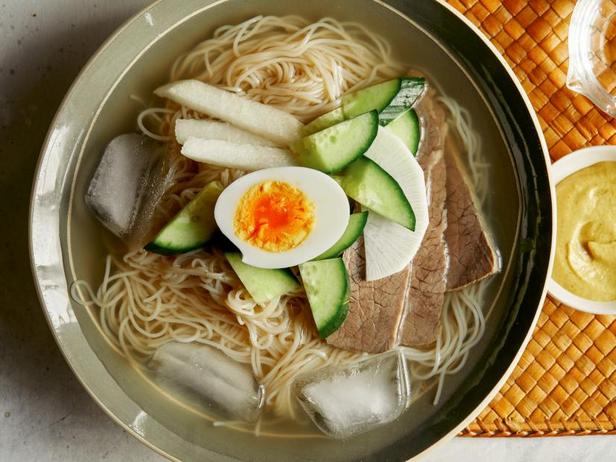
Mulnaengmyeon is a cold noodle dish served in an ice-cold broth with various garnishes or toppings, which can vary from restaurant to restaurant. While it's rare to make this dish from scratch at home, as Korean grocery stores offer a wide variety of refrigerated and frozen mulnaengmyeon, this recipe defies them. Mulnaengmyeon is just as delicious as restaurant-style, but made with more readily available ingredients. It can be served as a standalone dish or eaten after Korean barbecue. For a richer flavor, pairing the beef broth with the liquid from store-bought dongchimi (daikon kimchi) is recommended, but you can skip this step if you prefer the pure flavor of beef broth.
Nutritional value per serving:
Calories 1200, total fat 39 G., saturated fats 14 G., proteins 75 G., carbohydrates 134 G., fiber 13 G., cholesterol 375 mg, sodium 1633 mg, sugar 12 G.
Calories 1200, total fat 39 G., saturated fats 14 G., proteins 75 G., carbohydrates 134 G., fiber 13 G., cholesterol 375 mg, sodium 1633 mg, sugar 12 G.
Ingredients:
Bouillon
- 450 g boneless beef shank
- 450 gr. beef brisket
- 1 12 cm square of dried seaweed (kombu, dashima)
- 1 teaspoon black peppercorns
- 4 cloves garlic, peeled
- 2 green onions, white parts only
- A quarter of a small onion
- 30 g unpeeled daikon
- 3 tablespoons Korean soup soy sauce or light soy sauce
- 5 cups chilled liquid from container of daikon kimchi (or more, if needed) +
140 g radishes, sliced 0.3 cm thick, for garnish (see note) - Distilled white vinegar
For serving
- 2 large eggs
- Half a cucumber, cut into 4 parts and cut into 0.3 cm thick slices.
- 1 tablespoon distilled white vinegar
- 1 tbsp. granulated sugar
- Half a Korean pear, peeled and sliced into 0.5 cm thick slices.
Naengmyeon
- 620 g dry, chilled or frozen naengmyeon noodles
- Distilled white vinegar and yellow mustard, for serving
- Special equipment: gauze
1 glass (st.) - 250 ml.
3/4 cup (st.) - 180 ml.
2/3 cup (st.) - 160 ml.
1/2 cup (st.) - 125 ml.
1/3 cup (st.) - 80 ml.
1/4 cup (st.) - 60 ml.
1 tablespoon (tbsp) - 15 ml.
1 teaspoon (tsp) - 5 ml.
1/5 teaspoon (tsp) - 1 ml.
3/4 cup (st.) - 180 ml.
2/3 cup (st.) - 160 ml.
1/2 cup (st.) - 125 ml.
1/3 cup (st.) - 80 ml.
1/4 cup (st.) - 60 ml.
1 tablespoon (tbsp) - 15 ml.
1 teaspoon (tsp) - 5 ml.
1/5 teaspoon (tsp) - 1 ml.
We recommend





Preparation:
- Step 1
- Bouillon:
Place the beef shank and brisket in a large bowl and add cold water to cover. Let sit, changing the water if it becomes too cloudy, for 30-45 minutes. Drain thoroughly.
Step 2 - Meanwhile, pour 4 liters of cold water into a 6-liter cauldron or saucepan and add the dashima. Let it sit until the dashima has doubled in size and the water turns a light green-yellow, 30-45 minutes. Step 3
- Bring the water to a boil over medium heat; cook until the dashima begins to foam on the sides, about 2 minutes. Remove the dashima from the pot, then add the shank, brisket, black peppercorns, garlic, white part of the scallions, onion, and fresh daikon. Bring to a boil again, then reduce the heat to medium and simmer at a gentle simmer (maximum 2-3 bubbles breaking the surface), monitoring the broth and adjusting the heat if necessary every 30 minutes to prevent the broth from boiling over, until slightly reduced, 1 hour 15 minutes. Cover, reduce the heat to low, and simmer until the broth darkens, another 1 hour 15 minutes. Step 4
- Remove the meat from the broth and let it cool on a plate. Once the meat has cooled, slice it thinly and refrigerate it in a tightly sealed container until ready to serve. Using a slotted spoon or sieve, remove and discard the vegetables and black peppercorns from the broth. Pour the broth into a container, seal tightly, and refrigerate until completely chilled, about 8-12 hours. Once the broth has cooled completely, strain it through a sieve lined with cheesecloth. Step 5
- Season the cooled broth with soy sauce and 2 teaspoons of salt. Add the kimchi and daikon liquid and salt to taste. Add vinegar if desired. Refrigerate the broth until ready to use. Step 6
- Garnish:
Place the eggs in a small saucepan. Add enough cold water to cover them by at least 2 cm. Bring the water to a boil and cook over medium heat for 8 minutes. Using a slotted spoon, transfer the eggs to an ice bath to stop the cooking. Once cool, peel and halve lengthwise. Set aside.
Step 7 - In a medium bowl, combine the cucumber with vinegar, 2 teaspoons sugar, and 1 teaspoon salt. Toss to coat each slice. Refrigerate until ready to use. Step 8
- In a small bowl, combine the remaining 1 teaspoon of sugar with 1/2 cup of water. Add the sliced pear and set aside (this helps prevent the pears from oxidizing and browning). Step 9
- Naengmyeon:
Bring a large pot of water to a boil. Add the noodles and cook according to package directions. Drain the noodles in a colander and rinse under cold running water, gently swirling them around with your fingers. Drain, then rinse again, repeating this process two more times to remove all excess starch. Shake off excess water thoroughly and leave the noodles in the colander until ready to use. When ready to serve, rinse the noodles again as they may stick together.
Step 10 - Divide the noodles, boiled eggs, cucumber, pear, radish, and chilled broth into 4 large soup bowls. Add ice cubes to the broth. Serve immediately with white vinegar and yellow mustard.
Note
Daikon kimchi (dong chimi) can be found in the refrigerated kimchi section of Korean stores. It's often sold in 1.3 kg jars or 700 g containers.
Votes: 1
 Recipe author - Food Network
Categories
recipe / Calorie content of prepared meals / Main courses / Pasta / Vegetables and mushrooms / Eggs and dairy products / Soups / Clear soups / / Food Network - recipes / Asian cuisine / Korean cuisineAppetizers
Beer snacks
Cheese appetizers
Sandwiches
Snacks
Canapes
Assorted appetizers
Snacks with sauces
Meat appetizers
Fish appetizers
Vegetable appetizers
Egg appetizers
Soups
Cold soups
Creamy soups
Cream soups
Soups with dressings
Clear soups
Vegetable soups
Thick soups, stews
Meat soups
Fish soups
Soups with pasta and cereals
Main courses
Meat
Bird, game
Side dishes
Vegetables, mushrooms
Fish, seafood
Cereals, legumes
Eggs, dairy products
Pasta
Casseroles
Salads
Warm salads
Vegetable salads
Leafy salads
Fruit salads
Salads with cereals and pasta
Salads with meat
Salads with fish
Salads with eggs
Salads with beans
Salads with bread
Fast food
Hamburgers
Sandwiches
Hot dogs
Pizzas
Hot sandwiches
Tortilla Dishes
Pita dishes
Pancakes
Sauces for fast food
Deep-fried dishes
Sauces
Seasonings
Gravies
Dips
Spreads
Barbecue glazes and sauces
Salad dressings
Oil mixtures
Emulsion sauces
Sweet sauces
Hot sauces
Sauces for fast food
Grill, barbecue
Grilled meat
Grilled poultry
Grilled fish
Smoked dishes
Grilled vegetables and fruits
Grilled flour products
Barbecue glazes and sauces
Bakery
Savory pies, pizzas
Homemade bread
Potato pancakes, pancakes
Unsweetened buns, pies
Unsweetened cookies and muffins
Desserts
Cupcakes
Fruit desserts
Cookie
Cakes
Donuts, pies, buns
Candies and small sweets
Creams, sauces, mousses, puddings
Soufflé, meringues, meringues
Jelly
Ice cream, sorbets
Cakes
Sweet pies, tarts
Pancakes, fritters, waffles, toast
Breakfast cereals, granola, muesli
Drinks
Milkshakes
Smoothies, granitas
Coffee and chocolate based drinks
Fruit drinks, juices
Tea and herbal drinks
Hot drinks
Alcoholic cocktails
Cocktails with vodka
Cocktails with gin
Whiskey cocktails
Cocktails with wine
Cocktails with brandy, cognac
Cocktails with absinthe
Cocktails with rum
Cocktails with sparkling wine
Tequila cocktails
Cocktails with beer
Cocktails with liqueurs
Frozen cocktails
Cooking methods
Air fryer
Pressure cooker
Cold dishes
Multicooker
Stuffed dishes
Deep-frying
Double boiler
Pan
Baking tray
Foil
Oven
Roaster
Mixer
Blender
Brazier
Food processor
Microwave
Wok
Pickled dishes
Dried and cured foods
Pickled dishes
Poached dishes
Salty dishes
Smoked dishes
Canned goods
Seasonal dishes
Festive dishes
New Year
Christmas
Valentine's Day
March 8
Easter
May 1st
Halloween
Birthday
Party Dishes
Wedding dishes
Cocktail party
Dinner party
Mother's Day
Cuisines of the world
European
French
Italian
Spanish
Greek
English
Irish
German
Portuguese
Austrian
Polish
Russian
Scandinavian Swedish
Asian Chinese Japanese Thai Vietnamese Korean Filipino
Arabic Jewish Turkish
Indian
African Moroccan
American Hawaiian Cajun Canadian Tex-Mex
Latin American Mexican Venezuelan Argentine Brazilian
Caribbean Cuban Jamaican
Scandinavian Swedish
Asian Chinese Japanese Thai Vietnamese Korean Filipino
Arabic Jewish Turkish
Indian
African Moroccan
American Hawaiian Cajun Canadian Tex-Mex
Latin American Mexican Venezuelan Argentine Brazilian
Caribbean Cuban Jamaican
Categories
Breakfasts
Lunches
Dinners
Children's dishes
Dishes for future use
Budget recipes
Comfort food
Recipes for one
Recipes for two
Picnic
Backyard Recipes
Dishes for fans
Movie Night Dishes
Cooking methods
Food Network Recipes
Recipe collections
Recipes by ingredients
Healthy eating
Healthy breakfasts
Lunches
Dinners
Healthy snacks
Dishes rich in fiber
Gluten-free dishes
Low sodium content
Low-calorie dishes
Dishes for diabetics
Low-carb meals
Low fat content
Low cholesterol
Calorie content of prepared meals
Vegetarian dishes
Vegan dishes